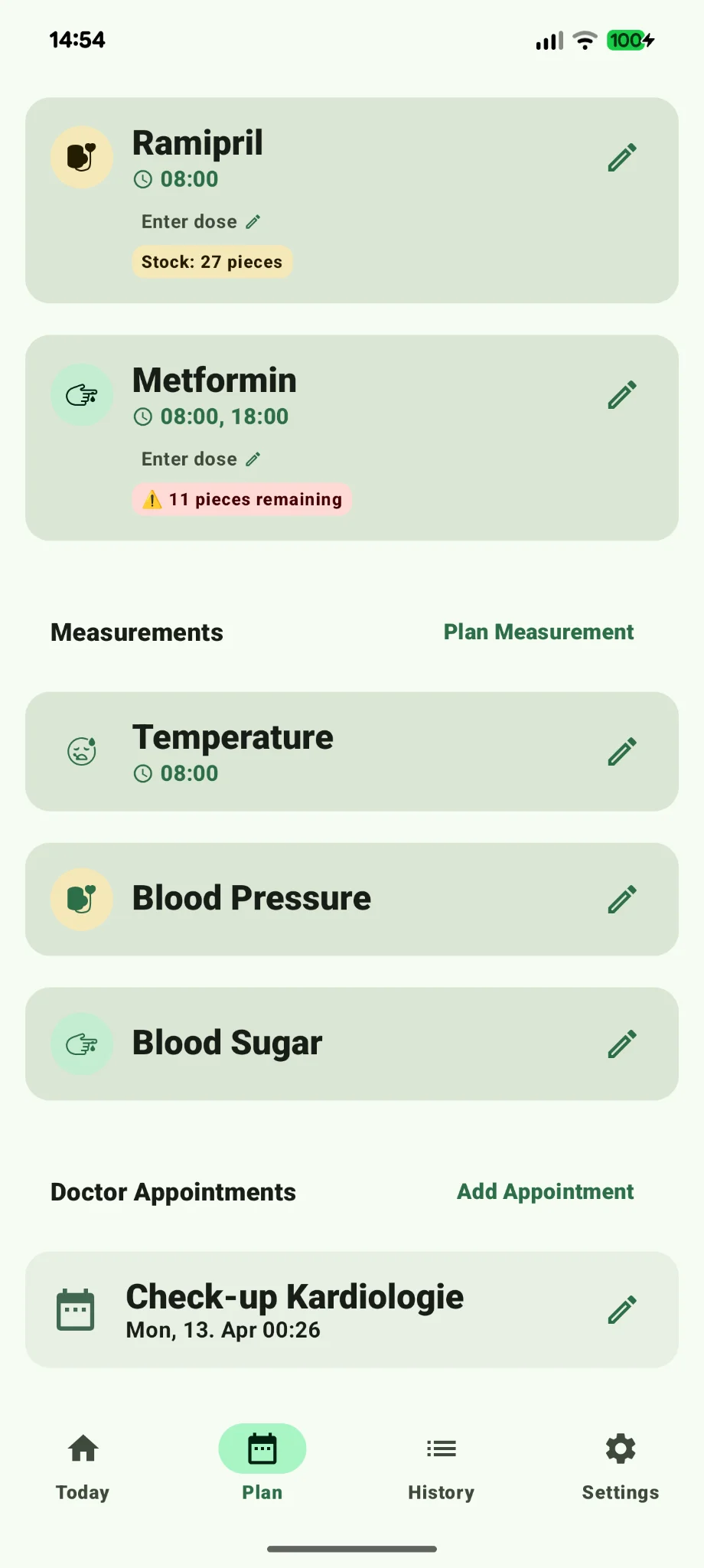
Printable blood pressure log
Four weeks of readings on two A4 pages: morning and evening, systolic, diastolic, pulse and notes. With a short measuring guide and the current blood pressure categories.
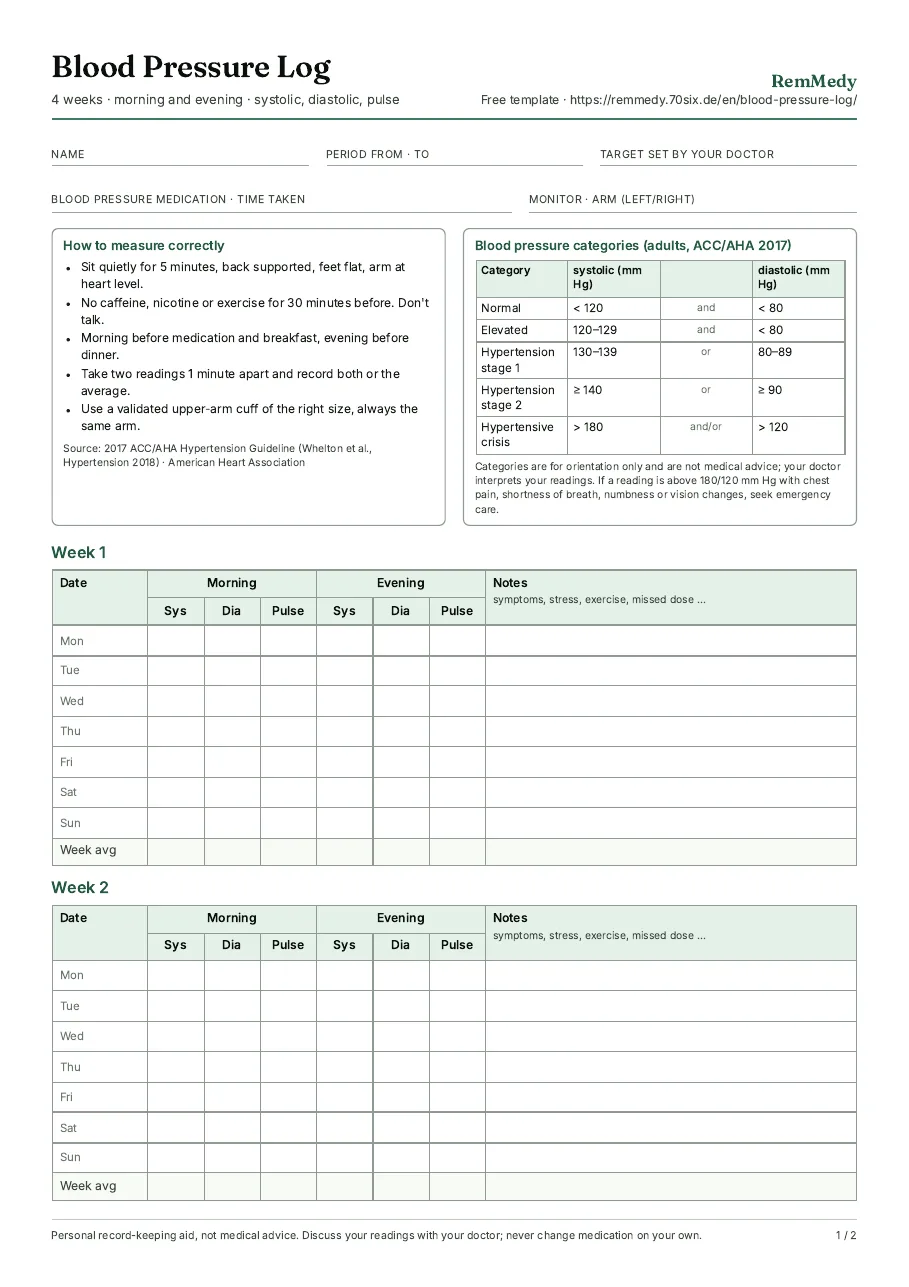
Blood pressure log (PDF, 4 weeks)
One table per week with seven days and a row for the weekly average. Page 1 also carries the measuring rules and the blood pressure categories, page 2 a summary box for your appointment.
- A4 portrait, 2 pages
- PDF, about 300 KB
- English
- 4 weeks, morning and evening
- Updated November 9, 2026
What's in the log
- Header: name, period, target set by your doctor, blood pressure medication and when you take it, monitor and arm. This keeps later logs comparable.
- Four weekly tables: seven days with date, morning and evening systolic, diastolic and pulse, a notes column and a row for the weekly average.
- Measuring rules and categories: the essentials for home measurement and the ACC/AHA 2017 categories right on the sheet.
- Summary: fields for the morning and evening averages, highest and lowest reading, number of readings and questions for your visit.
How to measure blood pressure correctly
A log is only as good as the readings in it. These rules follow the American Heart Association's guidance for home monitoring:
- Rest for five minutes seated, back supported, feet flat on the floor, legs uncrossed.
- Arm at heart level, cuff on bare skin on the upper arm, correct cuff size, validated monitor.
- No caffeine, nicotine or exercise for 30 minutes before, and don't talk during the reading.
- Morning before medication and breakfast, evening before dinner, at the same times each day.
- Take two or three readings one minute apart and record them all, or the average.
- Before an appointment, log at least a full week of morning and evening readings.
Sources: American Heart Association, Monitoring Your Blood Pressure at Home; Whelton PK et al., 2017 ACC/AHA Guideline for the Prevention, Detection, Evaluation, and Management of High Blood Pressure in Adults, Hypertension 2018, doi:10.1161/HYP.0000000000000065.
Understanding your readings
The categories below are the ACC/AHA 2017 classification for adults.
| Category | Systolic (mm Hg) | Connector | Diastolic (mm Hg) |
|---|---|---|---|
| Normal | less than 120 | and | less than 80 |
| Elevated | 120–129 | and | less than 80 |
| Hypertension stage 1 | 130–139 | or | 80–89 |
| Hypertension stage 2 | 140 or higher | or | 90 or higher |
| Hypertensive crisis | higher than 180 | and/or | higher than 120 |
Source: 2017 ACC/AHA guideline, blood pressure categories. This table is a general orientation and not medical advice; your doctor decides what your target is. If a reading is above 180/120 mm Hg together with chest pain, shortness of breath, back pain, numbness, weakness, vision changes or difficulty speaking, call emergency services.
How to fill in the log
- Complete the header, especially your target and medication. Without them nobody can judge later whether the readings are where they should be.
- Enter the date and write the three numbers for morning and evening: systolic, diastolic, pulse.
- Add a note whenever something was different: stress, exercise, missed dose, symptoms.
- Calculate the weekly average: add up the morning readings and divide by the count, then the same for evenings. Averages matter more than any single reading.
- Bring it to your visit and fill in the summary on page 2 beforehand so the conversation can focus on questions.
If you take several medications, pair the log with our printable medication schedule template.
Also available: blood sugar log (PDF)
For anyone who tracks blood glucose as well, or instead: the same format for four weeks with fasting, before and after breakfast, lunch and dinner, and bedtime readings, plus columns for insulin or tablets and notes. Tick your unit (mg/dL or mmol/L) at the top.
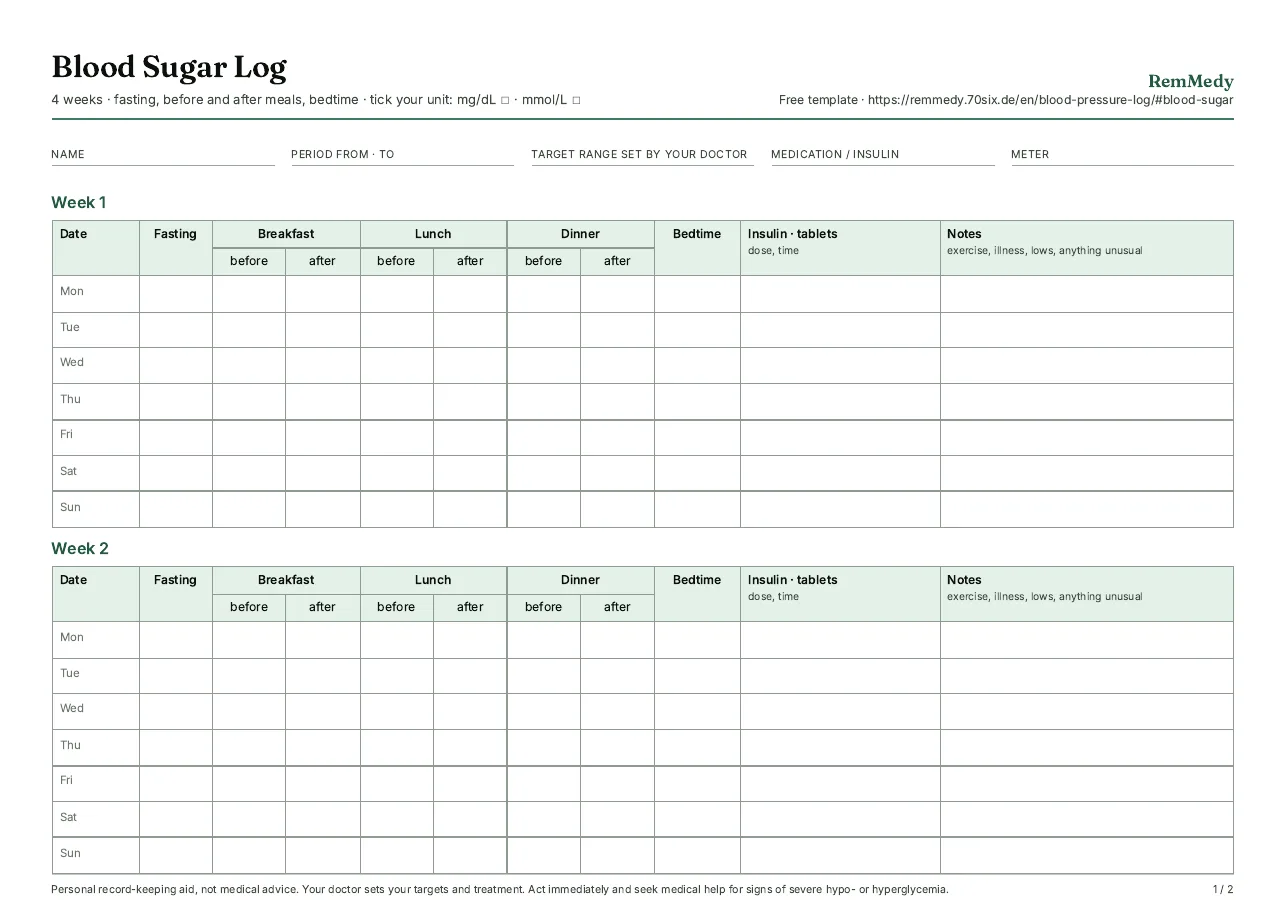
Blood sugar log (PDF, 4 weeks)
A4 landscape, two weeks per page. Columns for fasting, before and after each main meal, bedtime, insulin or tablets, and notes on exercise, illness or lows.
- A4 landscape, 2 pages
- PDF, about 170 KB
- mg/dL or mmol/L
Frequently asked questions
How often and when should I measure?
What is a normal blood pressure?
Should I write down every reading or the average?
What belongs in the notes column?
Is there a blood sugar version?
Can I keep the log digitally instead?
Related
- Printable medication schedule template (PDF)
- Pill tracker with measurements and trends
- RemMedy manual: recording measurements and exporting a PDF
Note: this page and the templates are a record-keeping aid, not medical advice. They do not replace an examination. Never change your medication on your own.
Prefer digital? RemMedy stores your readings and exports the log as a PDF.
Enter blood pressure, pulse and blood sugar in seconds, see the trend as a chart, export a PDF before your appointment. Offline, no account, no subscription.
The Android app (Android 8 and up) is available now on Google Play. The iPhone app (iOS 18+) is available on the App Store. Android and iPhone are separate purchases.